
How to Compare Soda Cans and 2-Liter Bottles by Cost Per Fluid Ounce
Soda prices are surprisingly hard to compare. One shelf tag shows a 12-pack of cans, another shows a 2-liter bottle, and the cheaper-looking option is not always the cheapest per ounce.
This guide focuses on the math problem only: how much soda you get for each dollar. The dedicated cost per fluid ounce calculator is built for this drink comparison workflow.
There are still real-life factors that may change your decision, such as whether your household will finish a 2-liter bottle before it goes flat, whether cans are easier for parties or lunchboxes, how much storage space you have, whether mini cans help with portion control, and whether a sale requires buying more than you actually need. But first, compare the price fairly by cost per fluid ounce.
🥤 The Golden Rule
Do not compare soda by shelf price, bottle count, or can count alone.
Compare it by:
Cost per fluid ounce = total price / total fluid ounces
Once every option is reduced to cost per fluid ounce, you can see which format is cheapest by raw math. Then you can decide whether convenience, waste, storage, or portion size changes the practical answer.
🧮 The 10-Second Formula
For cans:
Total fluid ounces = can size x number of cans
For 2-liter bottles:
1 liter = about 33.814 fluid ounces
2 liters = about 67.6 fluid ounces
You could do the arithmetic yourself, but the cost per fluid ounce calculator can handle the pack-count multiplication and unit conversion for you.
⚖️ The Comparison
Here is the clean version of the math:
| Soda format | Price | Calculator input | Cost per fl oz | What it tells you |
|---|---|---|---|---|
| 12-pack of 12 oz cans | $7.99 | 12 x 12 fl oz | 5.55¢ | Convenient, but higher per ounce here |
| One 2-liter bottle | $2.79 | 1 x 2 L | 4.13¢ | ⭐ Best value before waste |
In this example, the 2-liter bottle wins on raw cost per fluid ounce. But that does not automatically make it the best choice for every shopper. If some of the bottle goes flat and gets poured out, the real cost per usable ounce goes up.
The Flat Soda Check
If your household finishes 2-liter bottles quickly, the bottle may be the best value.
If you often throw away the last part because it goes flat, compare only the amount you expect to drink. For example, if about 20% of a 2-liter bottle is wasted, you are really using about 54.1 fl oz instead of the full 67.6 fl oz.
That changes the practical math:
$2.79 / 54.1 usable fl oz = about 5.16¢ per usable fl oz
At that point, the 2-liter bottle is still close, but it is no longer the obvious winner over cans. The bottle has the lower shelf price, but waste can erase much of the advantage.
How to Use the Calculator
Use the cost per fluid ounce calculator when comparing soda formats by total volume.
You do not need to calculate every total fluid ounce on your own first. The calculator lets you enter pack count and size per item.
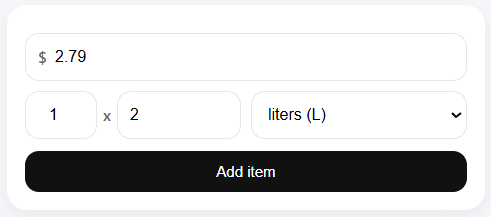
For example:
- 12-pack cans: enter 12 x 12 fl oz
- One 2-liter bottle: enter 1 x 2 L
- 24-pack cans: enter 24 x 12 fl oz
- Mini cans: enter 10 x 7.5 fl oz
- Two 2-liter bottles: enter 2 x 2 L
The calculator multiplies the pack count by the size per can or bottle, converts supported units when needed, and compares the unit price.
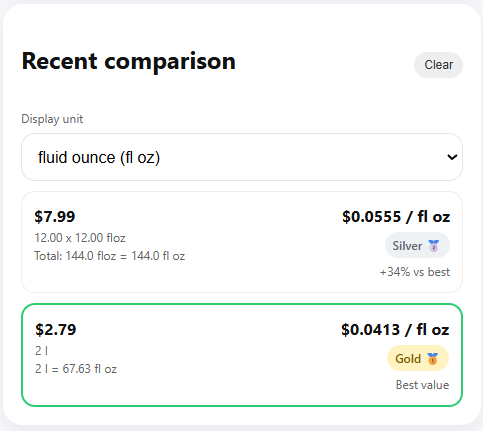
If you expect waste from opened bottles, use the amount you expect to drink instead of the full bottle volume. For example, if you usually drink only about 80% of a 2-liter bottle before it goes flat, compare against about 80% of the bottle volume.
⚠️ Common Soda Price Traps
The shelf-price trap
A lower shelf price does not always mean a better deal. A $2.79 bottle may be cheaper per ounce than a $7.99 12-pack, but only if you use most of the bottle.
The pack-count trap
A 24-pack is not automatically cheaper than a 12-pack. Compare the full pack size and price together, or let the calculator multiply pack count by can size for you.
The mini-can trap
Mini cans can be useful for portion control, kids, mixers, or avoiding waste. But they often cost more per fluid ounce.
The sale-bundle trap
"2 for $5" or "buy 3, save $2" should be compared using the total price paid and the total bottle count. In the calculator, enter the sale bundle as the number of bottles times the size per bottle.
The storage trap
A big multipack may have a better unit price, but it only helps if you have room for it and will actually use it.
The party trap
For parties, 2-liter bottles may be the cheapest and easiest to serve. For everyday slow drinking, cans may reduce waste.
Your 10-Second Soda Cheat Sheet
- For raw price math, compare cost per fluid ounce.
- For cans, use pack count x can size.
- For 2-liter bottles, remember that 2 liters is about 67.6 fluid ounces.
- For sale bundles, use the total price and enter the bundle count x bottle size.
- For slow-drinking households, adjust 2-liter bottles for likely waste.
- For mini cans, expect to pay more for smaller portions and convenience.
Related calculators
Use the volume calculator when the comparison depends on fluid ounces, liters, pack counts, or bottle counts. The all-in-one calculator can help with broader unit-price comparisons.
Next guide
If you want the broader foundation first, read the basic unit price guide so the soda comparison math makes even more sense.